Online Econometrics Resources

Assumptions-Classical-Linear-Regression-Model

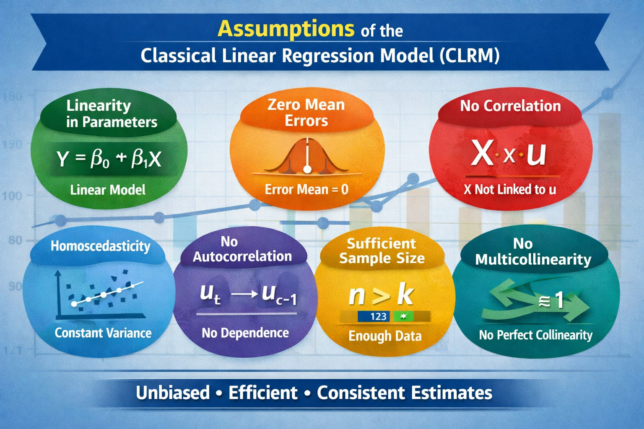
Assumptions of the Classical Linear Regression Model (CLRM) – With Clear Examples

The Classical Linear Regression Model (CLRM) is the foundation of econometrics. It ensures that Ordinary Least Squares (OLS) estimators are BLUE — Best Linear Unbiased Estimators. For this to hold true, certain assumptions must be satisfied. Let’s explore them step by step. 1. Linearity in Parameters 2. Zero Mean of Error Term 3. No Correlation […]

Assumptions of the Classical Linear Regression Model (CLRM) – With Clear Examples Read More »
Panel Data Analysis

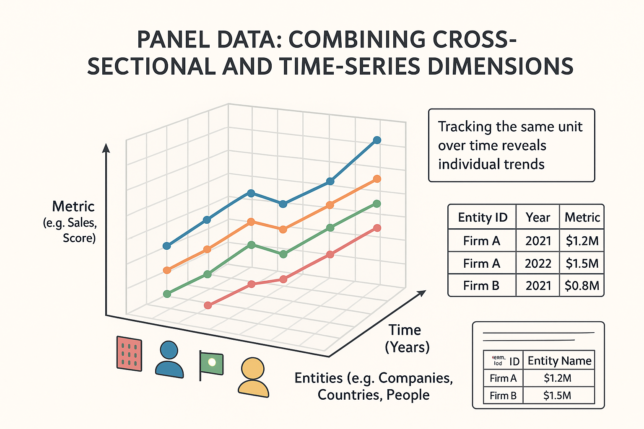
Analysis of Panel Data Fundamentals: Definitions, Methodologies, and Applications

1. Introduction to Panel Data Analysis Panel data, also known as longitudinal data, represents a powerful statistical framework that combines both time series and cross-sectional dimensions, enabling researchers to track the same subjects over multiple time periods. This unique data structure has revolutionized empirical research across numerous disciplines by providing deeper insights into dynamic changes

Analysis of Panel Data Fundamentals: Definitions, Methodologies, and Applications Read More »

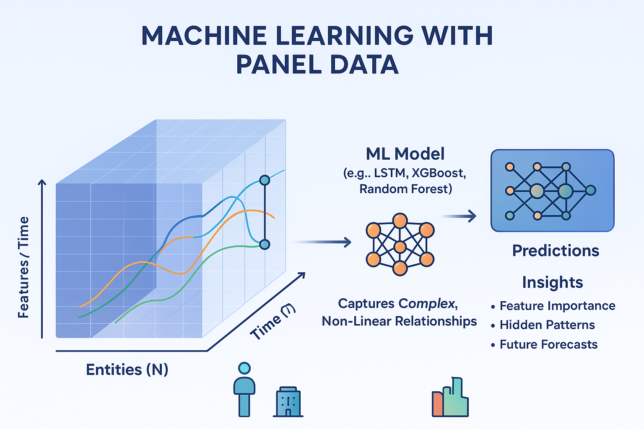
Machine Learning and Panel Data

Machine Learning and Panel Data: Revolutionizing Econometric Analysis

IntroductionIn the evolving landscape of econometrics, panel data—a dataset that tracks multiple entities over time—has long been a gold standard for understanding dynamic economic behaviors. From evaluating policy impacts to forecasting market trends, its ability to capture both cross-sectional and temporal variations makes it indispensable. However, the rise of machine learning (ML) is reshaping how

Machine Learning and Panel Data: Revolutionizing Econometric Analysis Read More »

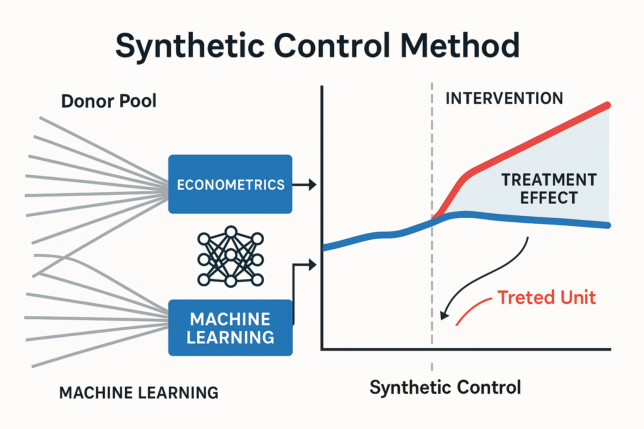
Synthetic Control Method-ML-Econometrics

Synthetic Control Methods (SCM) with Machine Learning (ML) and Traditional Econometrics

Synthetic Control Methods (SCM) with Machine Learning (ML) and traditional econometrics share the goal of causal inference, but they differ fundamentally in their approach, assumptions, tools, and applications. Here’s a breakdown of their key differences: 1. Core Philosophy & Methodology Traditional Econometrics SCM + ML Focuses on parametric models (e.g., linear regression, IV, DID) with strict assumptions (linearity, exogeneity). Uses non-parametric or

Synthetic Control Methods (SCM) with Machine Learning (ML) and Traditional Econometrics Read More »

CROSS-SECTIONAL DATA VS PANEL DATA

Understanding the Differences Between Cross-Sectional and Panel Data: The Pitfalls of OLS Regression in Panel Data Analysis

Difference Between Panel Data and Cross-Section Data Cross-sectional data and panel data are two distinct types of data structures used in statistical and econometric analyses, each serving different research purposes. Cross-Sectional Data: Panel Data: Key Differences: Understanding these differences is crucial for selecting the appropriate data structure based on the research objectives and the nature

Understanding the Differences Between Cross-Sectional and Panel Data: The Pitfalls of OLS Regression in Panel Data Analysis Read More »

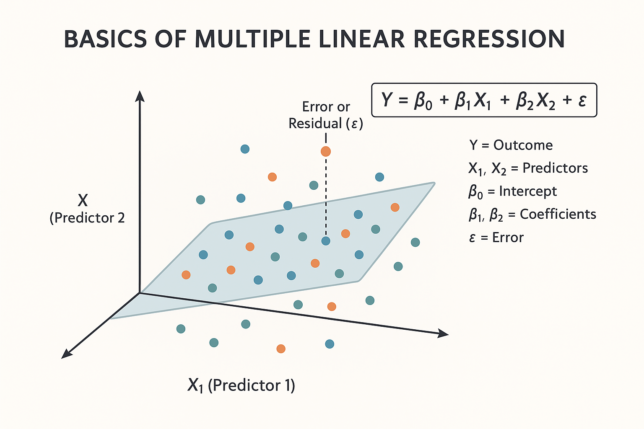
Basics-of-Multiple-Linear-Regression

The Basics of Multiple Regression Analysis: A Step-by-Step Guide

The Basics of Multiple Regression Analysis: A Step-by-Step Guide Multiple regression analysis is one of the most fundamental and widely used techniques in econometrics and data analysis. It is primarily used to understand the relationship between one dependent variable and two or more independent variables. This method allows researchers to isolate the effect of each

The Basics of Multiple Regression Analysis: A Step-by-Step Guide Read More »

Quantile Regression for Economists: How to Analyze Data Beyond the Mean with Tailored Insights

Quantile Regression for Economists: How to Analyze Data Beyond the Mean with Tailored Insights Quantile regression, introduced by Koenker and Bassett in 1978, is a technique that extends the traditional linear regression framework to estimate the conditional quantiles of the response variable rather than the conditional mean. In other words, instead of focusing solely on

Quantile Regression for Economists: How to Analyze Data Beyond the Mean with Tailored Insights Read More »

Understanding Heterogenous Treatment Effects: Methods for Estimating and Interpreting in Observational Studies

Understanding Heterogeneous Treatment Effects: Methods for Estimating and Interpreting in Observational Studies In the realm of observational studies, understanding how treatments affect different individuals is crucial for accurate policy making, healthcare decisions, and scientific research. This brings us to the concept of heterogeneous treatment effects (HTE), which refers to the variation in treatment effects across

Understanding Heterogenous Treatment Effects: Methods for Estimating and Interpreting in Observational Studies Read More »

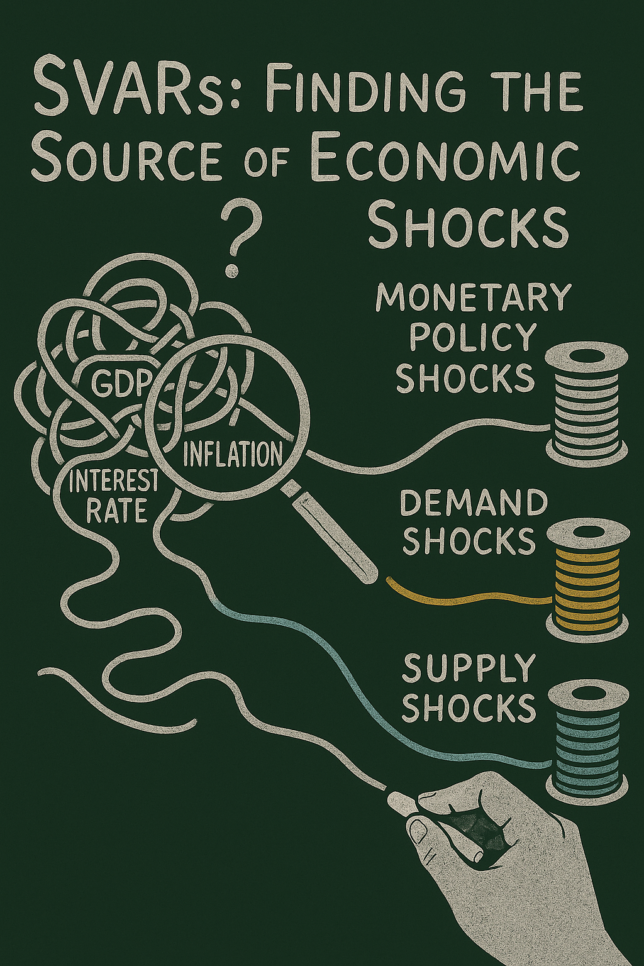
SVAR Models in Econometrics

Structural Vector Autoregressions (SVARs): An In-Depth Look at Identifying Structural Shocks and Understanding Their Macroeconomic Effects

Structural Vector Autoregressions In the realm of macroeconomic analysis, Structural Vector Autoregressions (SVARs) have emerged as a vital tool for identifying and understanding the impact of structural shocks on economic systems. Unlike standard Vector Autoregressions (VARs), SVARs incorporate theoretical constraints to discern structural shocks and their effects, making them essential for evaluating policy impacts and

Structural Vector Autoregressions (SVARs): An In-Depth Look at Identifying Structural Shocks and Understanding Their Macroeconomic Effects Read More »

Index